


News
PALMA SOLUTIONS JSC
Why Do Some Businesses Save 30% with Solar While Others Save Only 15%?
This is one of the most common questions Palma receives when consulting businesses on solar energy solutions.
Why do some businesses achieve over 30% savings while others only reach 15%?
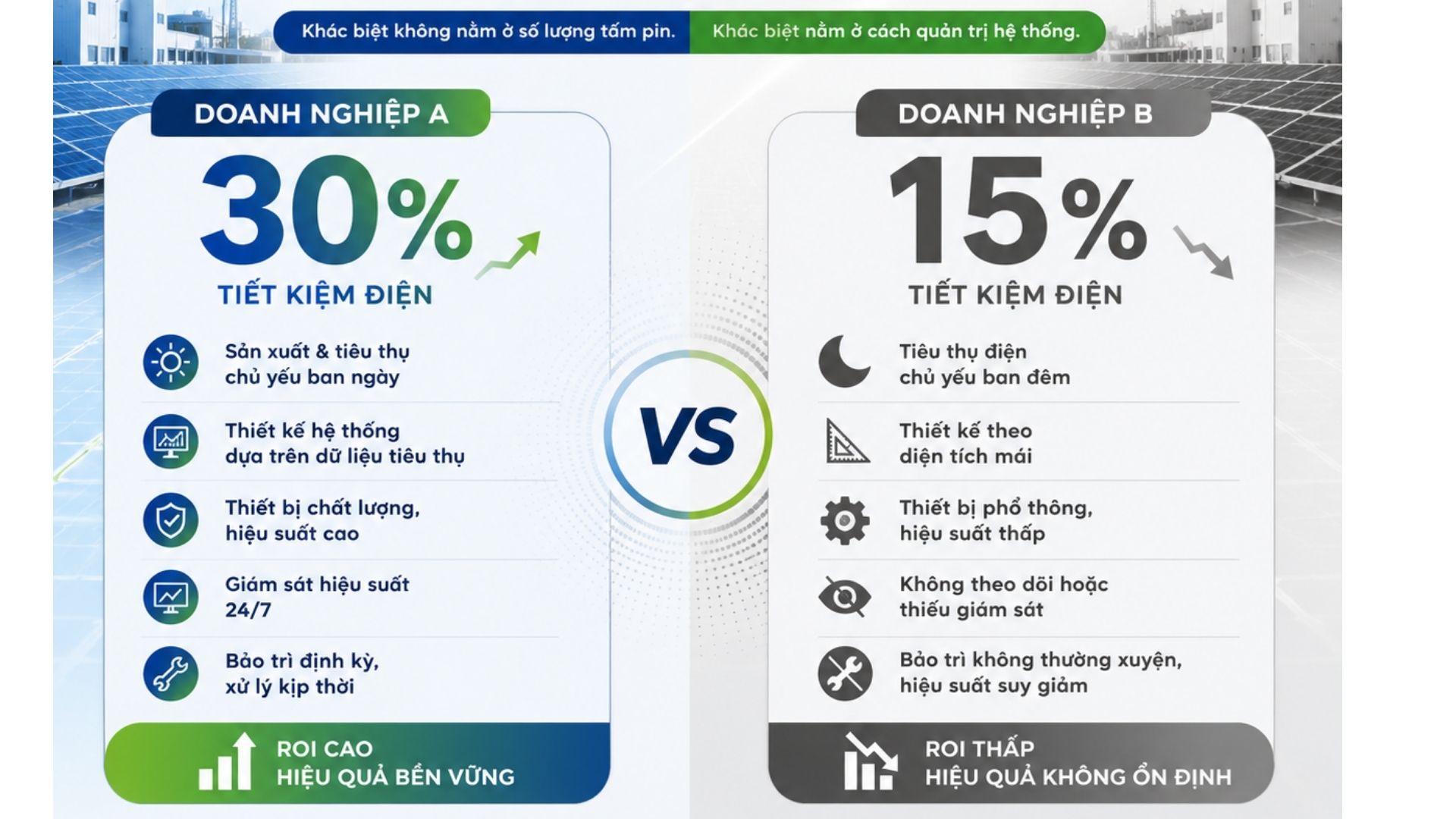
Many business owners want a clear answer before investing in a solar PV system: How much can we actually save on electricity costs?
The reality is that there is no universal savings rate that applies to every business. While some projects reduce monthly electricity costs by more than 30%, others may achieve savings of only 10–15%.
The difference is not simply due to better sunlight conditions or installing more solar panels. A solar PV system delivers its true value when it is properly designed around a company's actual electricity consumption profile.
When a system is correctly designed and efficiently operated, businesses not only maximize cost savings but also increase the amount of clean energy consumed on-site. This reduces dependence on grid electricity, lowers CO₂ emissions, and supports long-term sustainability and ESG commitments.
Every Business Has a Different Energy Profile
Solar PV systems generate the highest amount of electricity between late morning and early afternoon. Businesses operating continuously during these hours can consume most of the electricity as it is generated, significantly reducing their reliance on grid power.
On the other hand, facilities that mainly operate at night or have low daytime electricity demand may not fully utilize the energy produced during peak solar hours, resulting in lower overall savings.
For this reason, understanding a company's electricity consumption profile is far more important than simply determining the system size. Analyzing historical load data is the foundation of designing a solution that aligns with actual operational needs.
Bigger Systems Do Not Always Deliver Better Returns
Many businesses assume that maximizing rooftop space will maximize savings. In reality, oversizing a solar system can often extend the project's payback period.
If the installed capacity exceeds daytime electricity demand, excess generation may not be fully utilized. Conversely, an undersized system limits the business's opportunity to maximize long-term energy savings.
An effective solar solution is not defined by the number of panels installed but by selecting the right system size based on current electricity consumption while also considering future business expansion. This is why detailed site assessments and energy consumption analysis are essential before project implementation.
Equipment Is Only Part of the Equation
When comparing quotations, many businesses focus primarily on system capacity or upfront investment costs. However, long-term system performance depends on much more than these factors.
The quality of solar modules, inverter efficiency, string configuration, DC and AC cabling, protection devices, and overall system design all directly influence the amount of electricity generated throughout the project's lifecycle.
Two systems with the same installed capacity can produce significantly different energy outputs if they use different technologies, equipment quality, or engineering designs.
Beyond energy production, equipment quality also determines the system's long-term reliability. High-quality components backed by comprehensive warranties and selected according to site-specific environmental conditions help minimize operational risks, reduce maintenance costs, and improve the project's long-term return on investment (ROI).
In addition to financial benefits, maintaining stable system performance throughout its 20–25-year lifespan enables the generation of more clean electricity, reduces dependence on grid power, and supports corporate sustainability objectives. Choosing the right equipment is therefore not only an investment decision but also a commitment to long-term business value.
Small Details Can Have a Big Impact on Performance
During site assessments, seemingly minor factors can significantly affect system performance.
Water tanks, lightning protection poles, ventilation ducts, or shadows cast by nearby structures may reduce energy generation if they are not properly considered during the design phase.
A comprehensive site assessment should therefore go beyond measuring rooftop area. It should also evaluate roof orientation, tilt angle, shading conditions, and expected energy yield to ensure the most effective system design.
Long-Term Performance Depends on Effective Operation and Maintenance
Project completion is not the end of the journey.
To maintain consistent performance, solar PV systems require continuous monitoring and regular maintenance throughout their operational life.
Over time, dust accumulation, environmental conditions, or minor technical issues can gradually reduce system output without being immediately noticeable. Continuous monitoring and preventive maintenance help identify abnormalities early, maintain optimal energy production, and protect the long-term value of the investment.
Ultimately, the success of a solar project is not measured only on the day it is commissioned, but by its ability to consistently deliver value throughout its entire operational lifecycle.
Investing in Solar Means Investing in the Right Solution
There is no one-size-fits-all approach to commercial and industrial solar.
An effective solution begins with understanding how a business consumes electricity, followed by a comprehensive site assessment, appropriate equipment selection, optimized engineering design, and long-term operational support.
When every stage is carefully planned and executed, a solar PV system becomes more than just a way to reduce electricity costs—it becomes a long-term investment that strengthens operational efficiency, supports sustainability goals, and creates lasting business value.
At Palma, we partner with businesses throughout the entire project lifecycle—from feasibility assessment, engineering design, and system installation to operation and maintenance (O&M)—helping maximize investment performance while supporting a greener and more sustainable future.
Contact Palma's experts today to explore a sustainable energy roadmap tailored to your business.
26/06/2026 13:55:19
News other
_-08-01-2026-23-54-30.jpg "Why can the same solar technology deliver different performance across industrial plants?")


![[PALMA x NOVALAND] WORKSHOP ON MAINTENANCE AND SERVICING OF SOLAR LANDSCAPE LIGHT PLL-30 AT NOVA HILLS – MUI NE](https://palma.com.vn/upload/z3634653067260_15cb1f4d62b14f3a684fdf4ee9de4870_-11-08-2022-13-55-36.jpg "[PALMA x NOVALAND] WORKSHOP ON MAINTENANCE AND SERVICING OF SOLAR LANDSCAPE LIGHT PLL-30 AT NOVA HILLS – MUI NE")
_-06-02-2026-14-31-59.jpg "Understanding kWp and kWh: The First Step Toward Effective Solar Investment")
Search
Breaking news
_-24-10-2021-21-55-01.png "MicrosoftTeams-image (8)_-24-10-2021-21-55-01.png")
_-21-04-2022-13-38-01.png "PALMA SOLUTIONS JSC")
CONTACT US
MAP
Copyright © 2020 PALMA SOLUTIONS JSC
