


News
PALMA SOLUTIONS JSC
Understanding kWp and kWh: The First Step Toward Effective Solar Investment
When exploring or deploying a solar power system, businesses are consistently exposed to two units that appear throughout almost every consultation and technical document: kWp and kWh.
They are so commonly used that many assume they already understand them well. In reality, however, a significant number of investment decisions are still made based on misunderstandings between these two concepts.
So what do kWp and kWh actually represent? And why does understanding them correctly matter so much?
What does kWp represent?
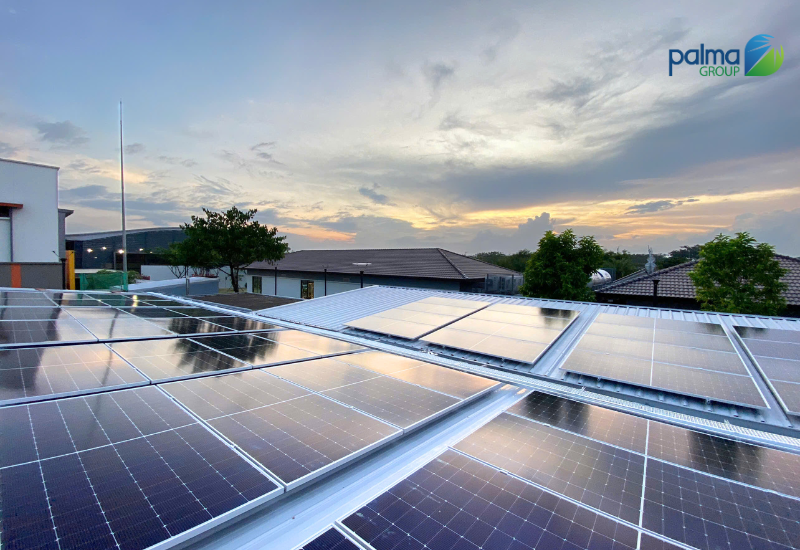
kWp (kilowatt-peak) reflects the installed capacity of a solar power system.
It indicates the maximum output the system can achieve under standard test conditions—when solar irradiation, temperature, and environmental factors are considered ideal.
Simply put:
kWp shows how powerful a system can be, not how much electricity it will actually produce during real-world operation.
For this reason, kWp is commonly used to:
- Compare system sizes
- Estimate initial investment scope
- Serve as a basis for technical design
However, kWp alone does not determine economic performance. That role belongs to kWh.
If kWp is capacity, kWh is performance
While kWp describes capability, kWh (kilowatt-hour) measures actual energy output - the amount of electricity generated and consumed over a given period of time.
It is the kWh figure that forms the foundation for:
- Calculating electricity cost savings
- Assessing alignment with consumption demand
- Determining system payback period
A system with a large installed capacity but an output profile that does not match operational demand may still deliver lower-than-expected returns.
Why can’t kWp be converted into kWh using a fixed formula?
A common misconception is that once kWp is known, kWh can be easily derived. In practice, the relationship between the two depends on multiple variables, including:
- Local solar irradiation conditions
- Roof orientation and tilt angle
- Operating hours and consumption patterns
- Equipment quality and system design
As a result, two systems with the same kWp installed at different facilities may generate very different kWh outputs.
This is precisely why “one-size-fits-all” solutions rarely deliver optimal results.
From a business perspective: what should come first?
During consultations, one of the most frequently asked questions is:
“How many kWp should we install?”
A more relevant set of questions would be:
- How many kWh does the business consume each month?
- During which time periods is electricity usage highest?
- Is the investment goal cost reduction, operational stability, or long-term sustainability?
Once these questions are clearly answered, the appropriate kWp capacity becomes the logical outcome of a well-structured analysis, rather than a number chosen based on intuition.
Understanding correctly for sustainable investment
kWp and kWh are not opposing concepts - they are complementary.
- kWp helps define technical scale.
- kWh reflects operational value and economic efficiency.
For businesses viewing solar energy as a long-term solution, understanding these two metrics correctly not only leads to more effective investments, but also helps avoid unrealistic expectations from the very beginning.
06/02/2026 14:38:24
News other
_-08-01-2026-23-58-52.jpg "“Operation & Maintenance – Palma Solar Light” Technical Training")


_-08-01-2026-23-54-30.jpg "Why can the same solar technology deliver different performance across industrial plants?")
![[PALMA x NOVALAND] WORKSHOP ON MAINTENANCE AND SERVICING OF SOLAR LANDSCAPE LIGHT PLL-30 AT NOVA HILLS – MUI NE](https://palma.com.vn/upload/z3634653067260_15cb1f4d62b14f3a684fdf4ee9de4870_-11-08-2022-13-55-36.jpg "[PALMA x NOVALAND] WORKSHOP ON MAINTENANCE AND SERVICING OF SOLAR LANDSCAPE LIGHT PLL-30 AT NOVA HILLS – MUI NE")

Search
Breaking news
_-06-02-2026-14-31-59.jpg "Understanding kWp and kWh: The First Step Toward Effective Solar Investment")


_-24-10-2021-21-55-01.png "MicrosoftTeams-image (8)_-24-10-2021-21-55-01.png")
_-21-04-2022-13-38-01.png "PALMA SOLUTIONS JSC")
CONTACT US
MAP
Copyright © 2020 PALMA SOLUTIONS JSC
