


News
PALMA SOLUTIONS JSC
STRATEGIC CORPORATE SUSTAINABILITY: FROM VISION TO EFFECTIVE EXECUTION
Introduction: Why Commitment Requires a Scientific Roadmap
In an era where environmental and social standards are becoming the new benchmarks for corporate reputation, the risk of "Greenwashing" is more prevalent than ever. However, the divergence between communication messaging and operational reality often does not stem from a lack of intent, but rather from the absence of a unified strategic management framework.
Based on the Corporate Sustainability Model by Taticchi & Demartini (2021), sustainability should not be viewed as a peripheral activity. Instead, it must be the core of the business strategy - a place where a long-term vision is translated into actions that create a competitive advantage and enduring financial performance.
1. Pre-Work Phase: Defining Core Value Propositions
Before launching practical initiatives, a firm must undergo a rigorous internal assessment (Pre-Work) to establish a solid foundation. Understanding the firm's current sustainability profile and building a clear Business Case for change are essential prerequisites.
This process helps the organization identify that pursuing ESG is not merely a social responsibility but a strategic choice to mitigate risks and capture new growth opportunities within the green economy. As highlighted in the model, sustainability can be a primary source of "opportunity, innovation, and competitive advantage," providing greater social impact.
2. Materiality Assessment: The Heart of Strategic Decision-Making
In a complex ESG ecosystem, attempting to execute all standards simultaneously often leads to resource fragmentation and inefficiency. This is where the Materiality Assessment serves as the strategic "filter" to identify substantive priorities (the "WHAT").
Fundamentally, a materiality assessment is the process of identifying the intersection between Stakeholder Needs (through surveys and engagement) and the issues that directly impact the Firm’s Strategic Choices and financial success.
Determining the "WHAT" – Defining Strategic Pillars:
Instead of spreading resources thin across all 17 Sustainable Development Goals (SDGs), a Materiality Assessment helps the firm select and focus on 3 to 5 Strategic Pillars.
For example: A packaging manufacturer might prioritize "Circular Economy" and "Resource Optimization," whereas a technology firm would focus its resources on "Data Security" and "Human Capital Development."
By accurately identifying material issues, a firm can optimize its resources, generate the most profound social impact, and reinforce long-term corporate financial performance. This is a critical step in mapping to the SDGs in a way that is both relevant and authentic to the business context.
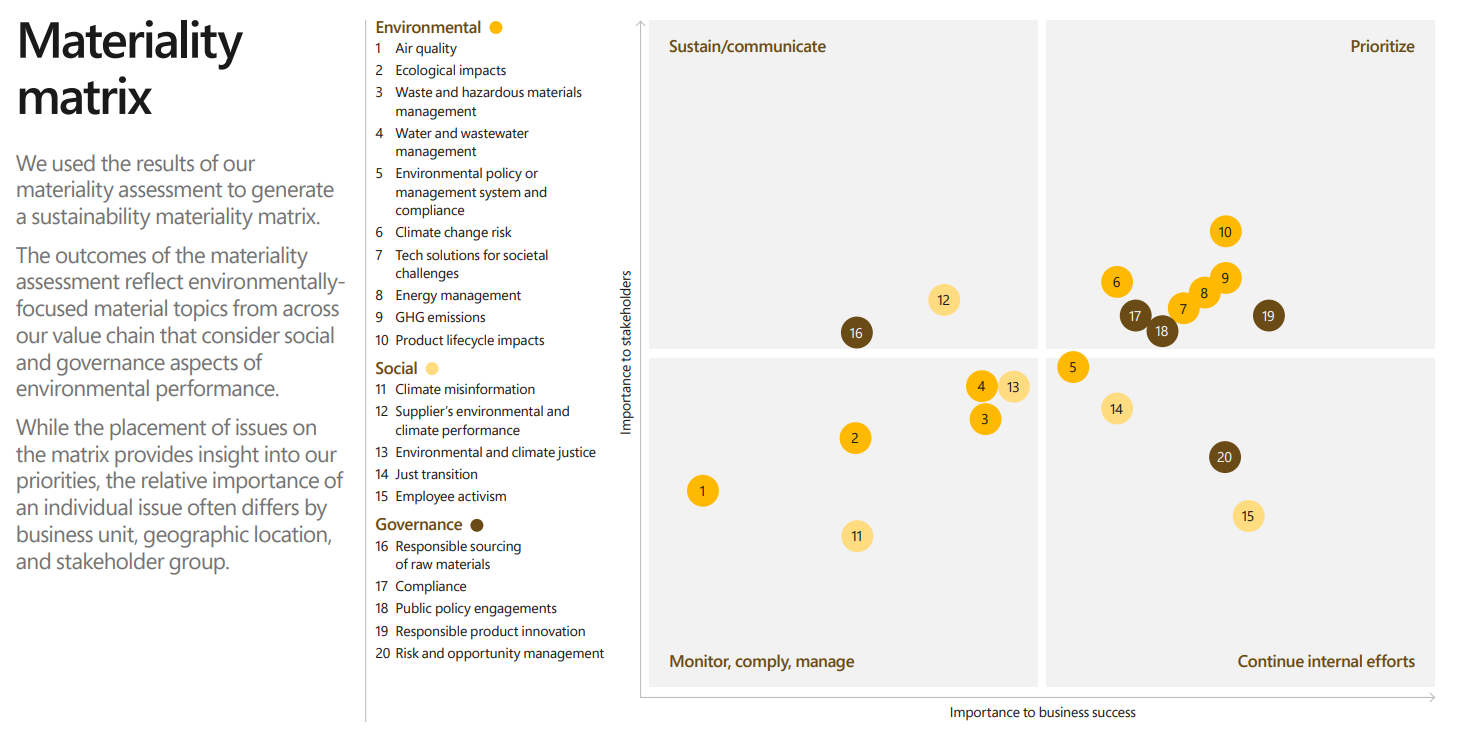
Source: Microsoft Sustainability Report 2020
3. Execution Mechanism: Embedding Sustainability into the Organization
To ensure the vision does not remain confined to planning documents, the implementation phase (The "HOW") requires a shift in management practices and alignment across all organizational levels:
- Aligning Strategy with a "Value Creating Story": Sustainability strategy must be embedded into the core business strategy, transforming ESG into a common language for value creation.
- Leadership and Change Management: Engaging top management and the board is the decisive factor in ensuring that sustainability practices are successfully embedded within the organizational culture.
- Measurement and Reporting: Establishing a roadmap with clear responsibilities and success measures. Consistent Measurement and Reporting serve as the empirical evidence of the firm's substantive commitment.
Conclusion: Toward Substantive Growth
Effectively applying the principles that guide a sustainability vision is a journey that demands discipline and strategic depth. When a firm correctly identifies its material issues, every "green" initiative is no longer a disjointed marketing effort but a firm step toward long-term prosperity.
About Palma:
Palma accompanies businesses in transparentizing their sustainability journey through empirical data and specialized technical solutions:
- ESG Strategic Consulting: Establishing materiality matrices and sustainable governance frameworks.
- Energy Audits & GHG Inventory: Accurately quantifying environmental impacts for compliance and reporting.
- Environmental Credit Solutions: Providing tools to help businesses realize their Net Zero commitments.
Contact Palma’s team of experts for a professional sustainability roadmap.
14/04/2026 17:21:13
News other
_-08-01-2026-23-54-30.jpg "Why can the same solar technology deliver different performance across industrial plants?")


![[PALMA x NOVALAND] WORKSHOP ON MAINTENANCE AND SERVICING OF SOLAR LANDSCAPE LIGHT PLL-30 AT NOVA HILLS – MUI NE](https://palma.com.vn/upload/z3634653067260_15cb1f4d62b14f3a684fdf4ee9de4870_-11-08-2022-13-55-36.jpg "[PALMA x NOVALAND] WORKSHOP ON MAINTENANCE AND SERVICING OF SOLAR LANDSCAPE LIGHT PLL-30 AT NOVA HILLS – MUI NE")
_-06-02-2026-14-31-59.jpg "Understanding kWp and kWh: The First Step Toward Effective Solar Investment")
Search
Breaking news
_-24-10-2021-21-55-01.png "MicrosoftTeams-image (8)_-24-10-2021-21-55-01.png")
_-21-04-2022-13-38-01.png "PALMA SOLUTIONS JSC")
CONTACT US
MAP
Copyright © 2020 PALMA SOLUTIONS JSC
